top of page
Tiffany
Biology
What is biology
Learning Contents
Biology courses are mainly exploring scientific study of life and living organisms. Whichexplain the structure, function, growth, evolution, and distribution of life.
Biology have five fundamental themes, will get deeper based on your level, : the cell as the basic unit of life, genes and hereditye, evolution of biological diversity, energy transformation for sustaining life processes, and the maintenance of internal stability.
Biology across multiple levels of organization.
Each of these fields applies a range of methods to investigate biological , including observation, experimentation, and mathematical modeling.
Biology 8
In Grade 8, biology is taught as part of the general Science 8 course not indiviully. Students begin with the cell theory. They will learn that all living things are made of cells and cells are the smallest unit of life.
They practice using microscopes and compare plant and animal cells, noting structures (part of cells) like the cell wall and chloroplasts.
The another big part are they study the difference between unicellular and multicellular organisms.
Futhermore, they also have to know the food chains, food webs, and energy pyramids.


Biology 10
In Grade 10, biology is taught within Science 10, mainly focus on ecology and human body systems.
Ecology topics include the carbon and nitrogen cycles, showing how matter is recycled in nature, and how human activities like deforestation and burning fossil fuels affect ecosystems.
Students also study biodiversity and invasive species, discussing why ecological balance is important.
In human biology cover the basics of the digestive system, respiratory system, and circulatory system.
Futhermore, experiments might include labs or models that show how the lungs function.
Biology 9
In Grade 9, biology content focuses heavily on genetics and cell division. Students have to learn about the structure of dna, the double helix, and te way genes determine traits.They are introduced to Mendel’s laws of inheritance and proccess of offspring.
In grae 9 courses they also increase classroom activites and group projects. Some include Punnett square exercises or extracting DNA from fruit.
Mreover, the students have to learn the differences between mitosis and meiosis, organisms grow and reproduce. This stage helps them to build up the baises, better understand grade 10 biology.
Life Science 11
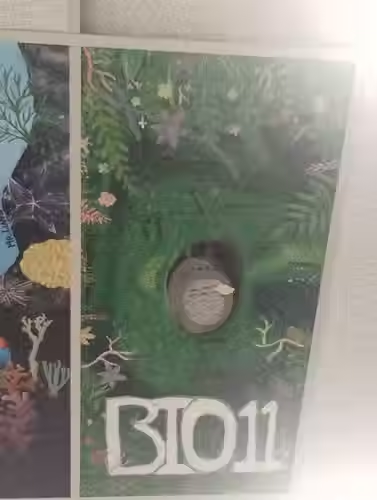
Grade 11 offers the first individuals biology course, Biology 11. Which goes much deeper into life sciences. A major focus is on the five biological kingdoms: bacteria, protists, fungi, plants, and animals. Students have to know their structures, life cycles, and ecological roles.
They also learn about evolution and natural selection, example for molecular biology.
Moreover, Lab is very important at this level. Students may dissect worms or frogs to compare organ systems. The goal of having individuals Biology 11 is to give students a broad view of life’s diversity


Anatomy and Physiology 12
In Grade 12, students advanced topics that resemble first-year university biology. The main focus is human anatomy and physiology,.
Ths course including detailed studies of the digestive, respiratory, circulatory, excretory, nervs, and endocrine systems. Students learn how these systems interact to maintain homeostasis.
THhey also have to study DNA replication, DNA transcription, translation, and protein synthesis.
Labs may include modeling DNA replication or investigating reflexes in the nervous system. Biology 12 is important for students preparing for university.
Observations

Biology 11/12
Plant cells
Animal cells



Cells


bottom of page